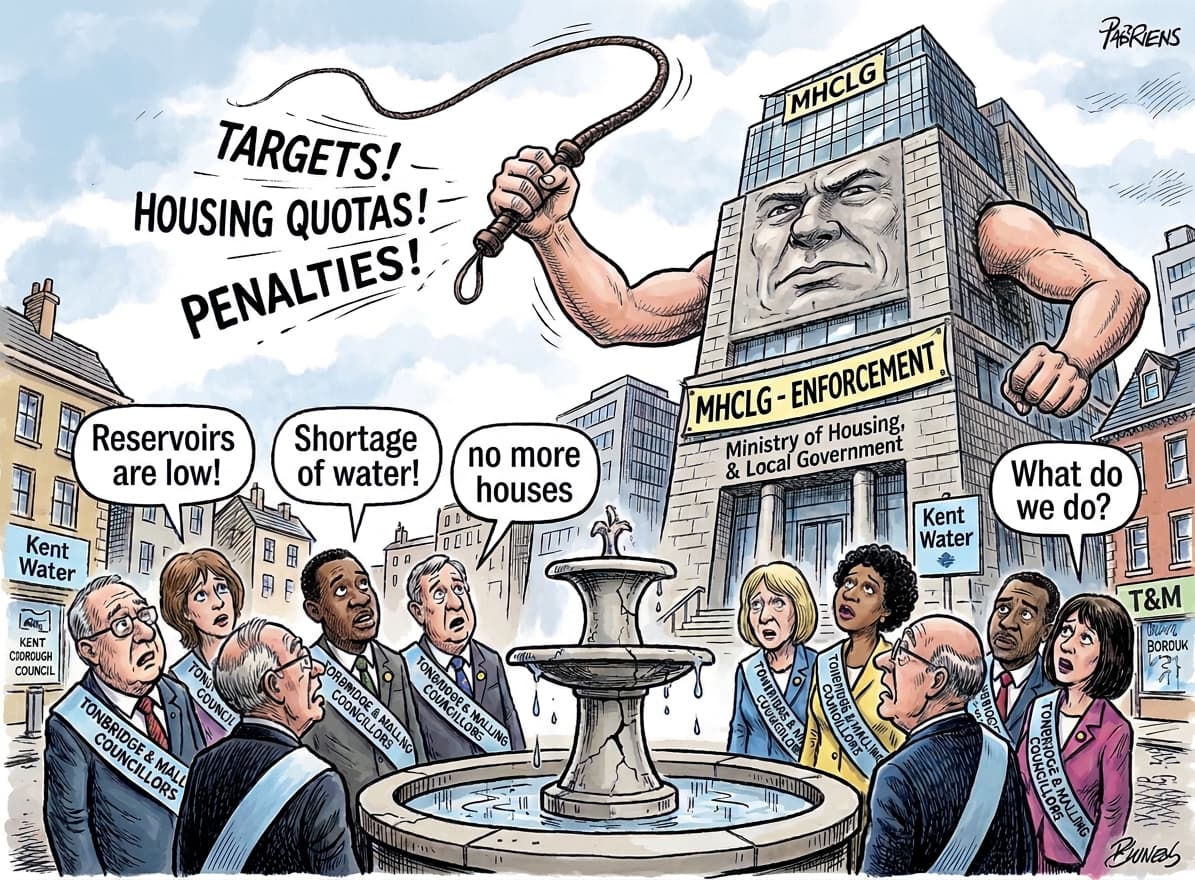
When Tonbridge and Malling councillors declined on 3 September 2026 to send their draft Local Plan out for final consultation, they gave a clear reason: water. A day later, Housing and Planning Minister Matthew Pennycook issued a statutory direction requiring the council to proceed anyway. The episode is the sharpest illustration yet of how the government now treats local plans, and it raises a question every infrastructure-constrained authority will recognise: what happens when the planning timetable and the utility timetable cannot be reconciled?
The minister’s approach to local plans
The government’s position is that England has gone too long without up-to-date plans. Fewer than a third of councils have one, and ministers have paired mandatory housing targets with firm deadlines. Authorities finishing plans under the legacy system must submit them by 31 December 2026, while those starting under the new system face commencement dates from 31 October 2026 onwards.
Mr Pennycook has been consistent that this is backed by force. He has said the government is prepared, in the last resort, to take plan-making out of local hands, and he has followed the warning with intervention letters. Stockport was told to revise its timetable after missing a deadline. Basildon, which has never adopted a plan under the 2004 Act, was warned of the risk of restarting. Torbay was challenged to justify a draft meeting only 42% of local housing need, and Southend and West Northamptonshire received directions of their own. Tonbridge and Malling is the case where the argument is most plainly about something other than housing numbers.
Why water became the issue
The borough’s emerging plan covers 2024 to 2042 and proposes around 20,106 homes, reflecting local housing need of 1,117 a year. Its largest allocation is land north of Borough Green, with roughly 2,000 homes expected in the plan period. Alongside it sit major sites around Tonbridge, Kings Hill, Snodland, Aylesford and Hildenborough.
South East Water, the area’s supplier, told the council that its current Water Resources Management Plan was built on 2023 housing data and does not reflect the uplift now being planned. It reported no spare supply headroom in the borough and said it could supply at most 6,318 additional homes to 2042, a fraction of the target. It added that major infrastructure improvements are not expected before 2032. Its next statutory plan is due to update the demand baseline in spring 2027, with proposed interventions following in spring 2028.
Local politicians seized on the gap. Tom Tugendhat, the MP for Tonbridge, told the Commons in March that there was not enough water for development on this scale and urged the government to cut the borough’s target. The council began treating water supply as a material consideration in planning applications, and in March councillors deferred an outline proposal for up to 1,300 homes at Aylesford until more evidence on potable water was provided.
The direction
Mr Pennycook’s letter of 4 September relied principally on section 27 of the Planning and Compulsory Purchase Act 2004, which allows the Secretary of State to intervene where a council is failing to do something necessary in preparing a plan. He also used section 15(4) to direct a revised Local Development Scheme. The council was required to:
begin Regulation 19 consultation by 11 September 2026, for at least six weeks;
submit the plan for examination by 31 December 2026;
refer any significant proposed modifications to the Secretary of State;
take no step to withdraw the plan, and report monthly to departmental officials.
The letter set out the justification: the existing plan dates from September 2007, Housing Delivery Test results were 60%, 54% and 63% across 2023 to 2025, the council had 2.89 years of housing land supply, and the affordability ratio stood at 12.03. It also stated that refusing to progress on 3 September put the December submission deadline under serious threat. The council has since confirmed it will proceed.
Importantly, the direction does not declare the plan sound, resolve the water problem or compel anyone to grant permission for 20,106 homes. The minister’s stated aim is to give the plan the best chance of adoption under the legacy system, with an Inspector deciding whether it is legally compliant and sound.
Two readings
The government’s case is that a 19-year-old plan, years of under-delivery and deteriorating affordability justify firm action, and that examination is the proper place to test water evidence. Stopping a plan before an independent Inspector can assess it, on this view, simply prolongs uncertainty and leaves the area exposed to speculative applications and appeals.
The council’s case is that asking it to submit a strategy it cannot show to be deliverable is the wrong way round. Its leader said members did not want to proceed without a guarantee of water supply to the homes proposed, and the water company’s own figures give that concern weight. A plan that allocates land without a credible route to supply may be found unsound, or may deliver permissions that cannot become homes.
What happens next
The battleground moves to examination. The Inspector will test whether the strategy is justified, effective and deliverable, and South East Water, the council and developers will all have the opportunity to make representations. Phasing, water-efficiency policies and infrastructure conditions may help manage risk, but no planning policy can create treatment capacity or a new strategic source.
For developers and landowners, the lesson is that intervention accelerates the process without removing the evidence burden. Water is now a live planning constraint in parts of the South East, and the cases that prosper will be those with a credible, phased answer to supply. For other councils, Tonbridge and Malling is a warning that infrastructure uncertainty is unlikely, on its own, to justify stopping the clock.
← Back to Council Watch