
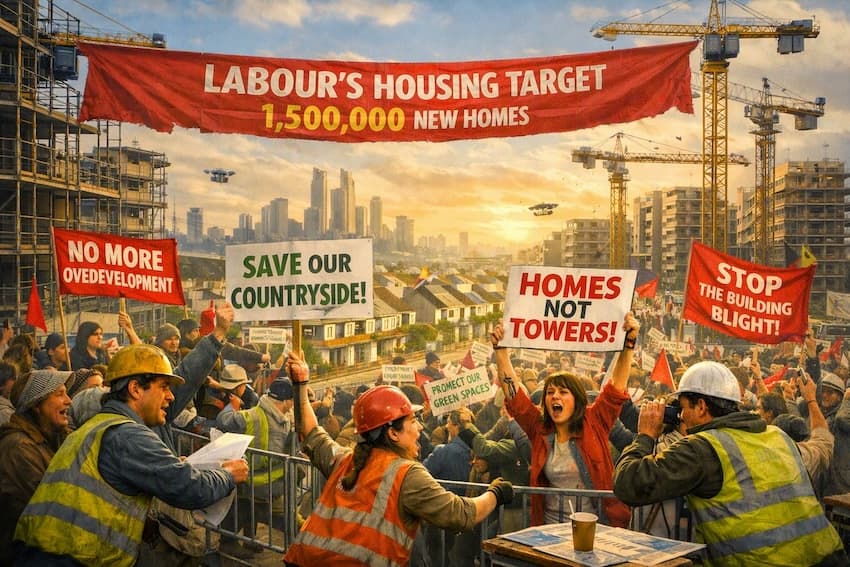
Reaching the New Homes Target
With the 1.5 million homes target unchanged, the Government is looking at growth funding, planning intervention and City Region mayors to drive up housebuilding, but the numbers remain a long way short.
Public investment into housing
The new Burnham led Government is keen to find ways in which it can speed up house building and other infrastructure projects. The new Chancellor, John Healey, is taking up the challenge initiated by his predecessor, Rachel Reeves, to find ways of raising funds for investment and growth without breaking the fiscal rules. The new Housing Secretary, Angela Rayner, has reiterated that the Government’s new homes target remains at 1.5 million but realises this will be difficult to achieve.
Finding New Money Within the Fiscal Rules
There has been speculation in the last few days that a growth fund worth £9 billion up to 2031 could partly be used to give preferential loans to developers, allowing them to use sites that would otherwise be unavailable. The funds could provide grants, loans and equity investment. The Government is looking to give more powers to Mayors and local authorities to release resources to allow investment into new housing and developments to take place in their own areas.
The Treasury is likely to remain tight lipped about this until all is revealed in John Healey’s first Budget on 28th October, so we do not know for sure how this will work, but the goal is to find ways of speeding up the building programme.
Making the Planning System Work
At present, the Housing and Planning Minister of State, Matthew Pennycook, is intervening where local authorities are not meeting new housing targets. In Basildon, he intervened as the authority had not updated its local plan in 27 years and had a poor record on delivery, where it seems there had been too much concern over environmental issues.
Elsewhere, he recently backed the planning inspectorate where Wiltshire County Council had turned down an application for 300 new homes on disused farmland, so the scheme will go ahead despite local objections.
“Not in My Back Yard”
But there is an early indication that there may be some problems further down the line, particularly where local authorities changed hands last May. Less than two months ago the Reform led West Northamptonshire Council rejected a recommendation to build 850 new homes because of local community objections. However, the decision went against the advice of officers and other councillors.
It is expected that there will be more hurdles like this to overcome in the months ahead. Apparently, the Minister in this case has not called it in.
Challenges and Opportunities for House Building
In areas particularly where the Greens have gained control, there is likely to be more pressure to build homes which meet environmental requirements, or even quotas higher than average for social and affordable housing.
Conservative Mayor of Tees Valley, Ben Houchen, who objected to using tax revenues, has instead launched a Regional Wealth Fund in the hope of achieving the same objective in terms of investment for the area. But the Tees Valley Mayor in the last fortnight has backed a new housing project supported by the Government backed Brownfield Housing Fund, which will provide 1,085 new homes in the Middlesbrough area.
Get London Building
Earlier this year, the London Mayor, Sadiq Khan, managed to secure £11.7 billion for a 10-year housing plan across London for the London Social and Affordable Housing Programme, where the initial bidding plan submission deadline has already passed.
The Mayor has agreed to allow London Boroughs to set their own affordable housing targets in 2028, where last year he had lowered it to 20%. Some authorities are likely to set them as high as 35%, while others may remain at 20%.
The problem for London is that very few new homes are being built, with only just over 4,200 completions last year, falling behind other areas. According to BBC reports there were 5,547 new starts in the private sector in 2025 compared with 33,782 in 2015 – a drop of 84%. The Government was hoping London would provide 170,000 of the 1.5 million homes target across the country. The rate of new build would have to rise more than 10-fold.
Some experts believe that there is potential in London to accommodate over 400,000 new homes. Many factors have contributed to the rapid decline in new homes and, although starts have increased since last year, they are a long way short. Ultimately, it is the number of new homes that the Government and London will be judged by – not what sort of housing.
City Regions as Drivers
In the Liverpool City Region, led by Mayor Steve Rotheram, there are over 800 brownfield sites which would allow for 42,000 new homes. Their 2043 City Region plan is currently being worked upon, but they plan to have 64,000 new homes over that time across 300 sites (over 30,000 will be in Liverpool itself). Under the Brownfield Housing Fund, they are planning to have 20% affordable/rented housing.
Manchester hopes to achieve its 32,000 new homes by 2032. Last year it built more new homes (4,766) than all the London Boroughs put together (4,261). The new Mayor of Manchester, Beverley Craig, has now set a target of 75,000 new homes, which would require a massive increase in building across the City Region. Manchester, like London, will have to dramatically increase its rate of building if it is to reach its target.
In the North East, Mayor Kim McGuinness has issued her 10-year plan for 15,000 more affordable homes and social housing but does not state the overall target for homes to buy. Similar targets have been set in authorities like the West Midlands, West Yorkshire and South Yorkshire, where the focus is on new affordable or social housing, but again the overall targets are not clear.
There is also the issue of improving existing housing, where there is a significant quantity of local authority owned housing stock which is not currently fit for use, or is tenanted but needs improving.
Can the 1.5 Million Homes Target Be Reached?
It is looking increasingly difficult, even if there is Government intervention to help increase house building. Overall, the homes built in areas covered by City Region Mayors would only account for a proportion of the Government’s targets. The bulk will still come from the many smaller authorities up and down the country.
In the first two years the Government estimates 392,000 new homes (26%). That means building over 1.1 million new homes in the next three years, which means an average of over 365,000 new homes per annum.
The Budget in October will provide an indication of how far the Government will go to drive up housing starts. We will wait and see.
Key Takeaways
- A growth fund worth £9 billion up to 2031 could be used in part to provide preferential loans, grants and equity investment to developers
- Mayors and local authorities are set to receive more powers to release resources for housing and development in their own areas
- Matthew Pennycook is already intervening where local authorities are not meeting housing targets, including in Basildon and Wiltshire
- Local opposition remains a risk, with the Reform led West Northamptonshire Council rejecting 850 new homes against officer advice
- London built just over 4,200 homes last year and would need to increase its rate of building more than 10-fold to deliver its 170,000 share
- Manchester built more new homes last year (4,766) than all the London Boroughs put together (4,261)
- With 392,000 homes estimated in the first two years, over 365,000 new homes a year would be needed for the remaining three years
Explore More Insights
Discover more articles on planning policy, community engagement, and the political landscape shaping development.