
Who decides? The politics of moving planning decisions from committee to officers
England’s National Scheme of Delegation shifts more planning decisions from elected committees to officers. What does that mean for local accountability, political opposition and applicants?
From 31 October 2026, under the Planning and Infrastructure Act 2025, a new National Scheme of Delegation changes who determines planning applications in England. Officer delegation becomes the default, and only certain permissions listed in Schedule 2 of the Regulations can go to committee. Alongside the revised NPPF, it is one of the biggest shifts in how development is consented in a generation. The politics are likely to matter as much as the mechanics.
What is changing
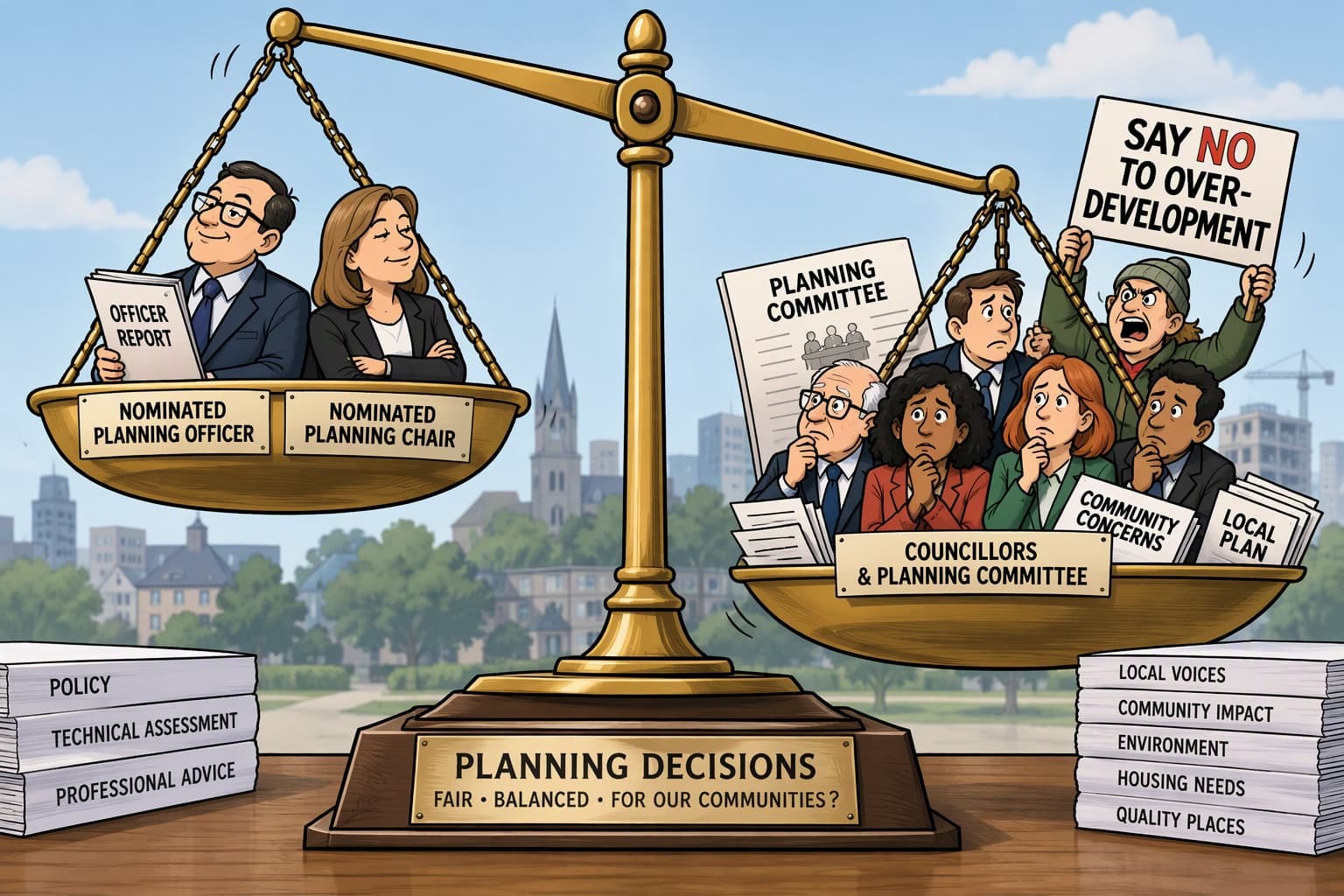
Applications in Schedule 2 are presumed to be delegated to officers, but remain eligible for referral to committee where the statutory gateway criteria are met and both the nominated officer and nominated member agree. The nominated officer is usually the Chief Planning Officer, and the nominated member is usually the committee Chair. If they cannot agree, an officer decides under delegated powers.
The government's case rests on delivery. Ministers link the reforms to the target of 1.5 million homes in England and fast-tracking 150 major infrastructure decisions. Committee overturns of officer recommendations that then fail at appeal, sometimes with costs awarded, are the cited evidence of a problem.
The democratic objection
The strongest criticism is about legitimacy rather than speed. The LGA, which is Labour-led, accepts that a national scheme could in principle bring clarity, consistency and efficiency, but warns that councillors' involvement is "the backbone of the English planning system" and could be eroded. It also notes that councils approve nine in ten applications that come before them, which suggests committees are not the main obstacle to growth.
Opposition has spread beyond the LGA:
• The Liberal Democrats argue that many decisions will move from elected councillors to officers, and that ward councillors' ability to call in applications for public debate will be severely restricted.
• Vale of White Horse District Council warned that its committee hears roughly 30 to 40 complex and contentious applications a year, and that around three-quarters of those it has heard in recent years would not have reached committee under the scheme.
• In Cheshire, councillors called the changes "undemocratic" as they considered the constitutional changes needed to implement them.
• Conservative group members at the LGA have also pointed to the LGA's agreed concerns about the scheme and its implications for planning committees.
Opposition is cross-party, though it has different motives. For some it is a principled defence of local democracy. For others it is a way to attack a central government plan that takes power from local politicians.
The accountability gap
Delegation moves the political risk, but it does not remove it. When a contentious scheme is approved by committee, councillors own the decision. When it is approved by an officer, residents may still hold their elected representatives responsible, but those representatives can no longer vote on it.
This could strain relationships in several places:
• Ward members and residents. Councillors may end up explaining decisions they had no part in.
• Chief Planning Officers. The role becomes much more exposed. It remains to be seen how many will be willing to insist on delegated determination where the Chair wants committee.
• Committee Chairs. The gateway test requires the Chair to agree with the officer, so a Chair who wants a referral can be blocked.
Officers are also not insulated from politics. Their recommendations carry more weight than before, and their independence and workload will be scrutinised.
Where the real fight moves
The committee room is not the only place for local opposition. Some of it may move earlier, to local plan examinations and site allocations. CPRE has argued that committees' local knowledge has sometimes been found material by planning inspectors, which suggests that removing it could change outcomes. Campaigners may put more effort into plan-making, into influencing the consultation record, and into judicial review of officer decisions.
The new NPPF policies are also already shaping appeals. One legal commentary says recent appeal decisions suggest Policies S4 and S5 (principle of developments within and outside settlements) are already reshaping the planning balance. A system that leans more heavily on national policy and officer judgement will see more argument about how those policies are applied.
What it means for applicants
For applicants, the likely benefit is more certainty and fewer committee delays on policy-compliant schemes. Three things are worth planning for:
• Early engagement. Where an application is eligible for referral, how the nominated officer and member are likely to view it matters. Each authority's process will be set out in its own constitution, so approaches will vary.
• Community engagement. A scheme can still run into trouble if opposition is ignored, even if it is decided by an officer. Local resistance may show up as complaints, challenge or reputational risk.
• Policy compliance. A proposal that sits clearly within the plan and the NPPF is the most likely to benefit. If it is clearly within policy it will be decided via delegated powers.
Authorities are also being advised to name their nominated officers and members, with deputies, and set out a transparent process for assessing referrals. Implementation quality will probably vary between councils.
The bottom line
The scheme trades democratic involvement against delivery speed. Whether it works will depend less on the regulations than on how nominated officers and members use their discretion in practice. The first test is likely to be the first high-profile scheme where an officer approves against a Chair's wishes, or where a Chair is overruled.
Key Takeaways
- Officer delegation becomes the default for more planning applications, with committee referrals subject to specified criteria.
- Removing routine councillor call-in powers raises questions about democratic accountability.
- Local political opposition may shift towards plan-making, consultations and legal challenges.
- Policy compliance, early engagement and local understanding will be important for applicants.
Explore More Insights
Discover more articles on planning policy, community engagement, and the political landscape shaping development.