
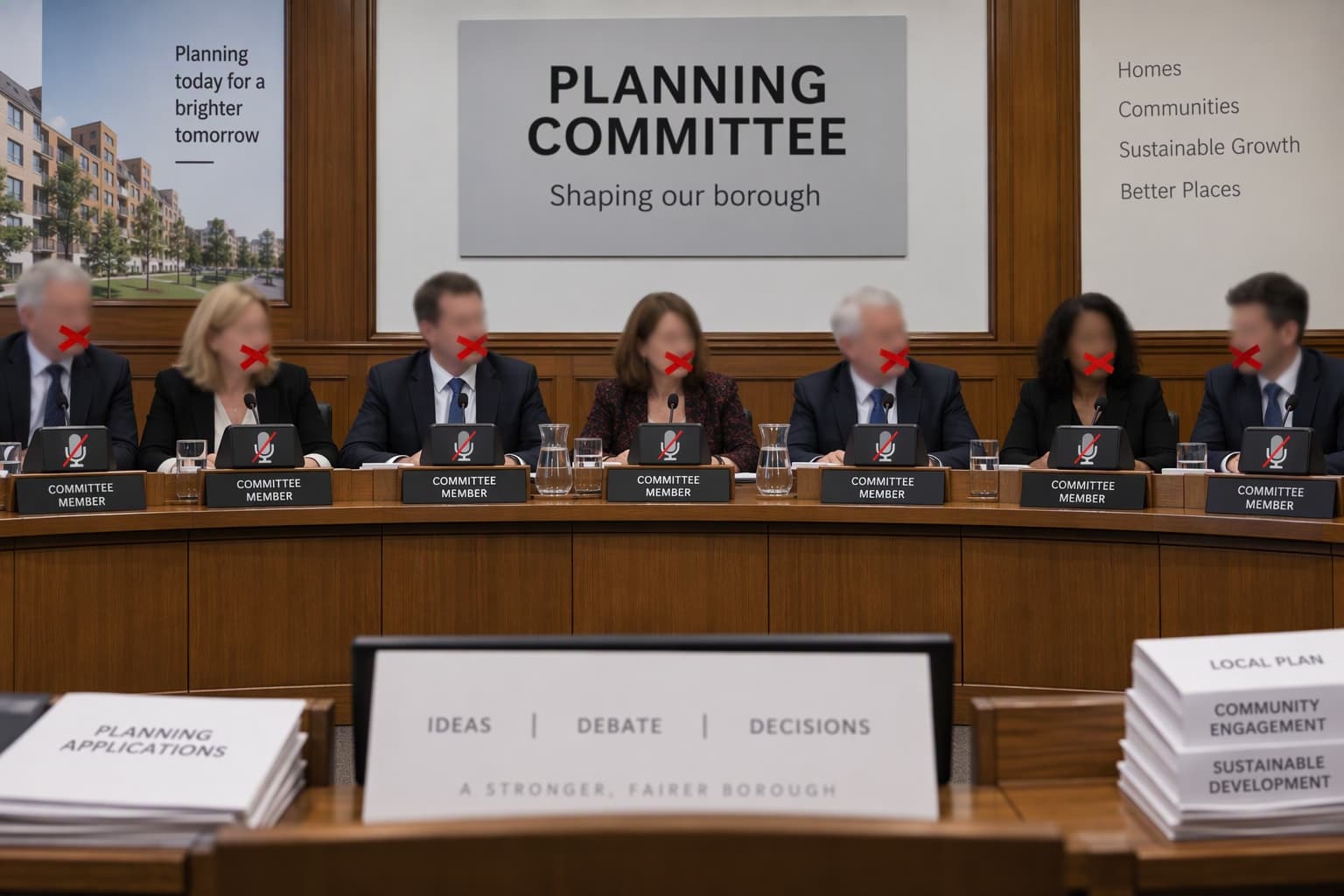
Complying, grumbling, adapting: how councils are responding to planning delegation
As councils implement the National Scheme of Delegation, local politicians are challenging the loss of call-in powers while planning authorities adapt their procedures.
With the National Scheme of Delegation taking effect on 31 October 2026, local planning authorities across England have spent the summer rewriting their constitutions. The picture that emerges from council papers and meeting reports is not one of rebellion. It is closer to reluctant compliance, with real anger about one change in particular and a growing focus on how to make the new system work.
A legal deadline, not a choice
The Town and Country Planning (Discharge of Local Planning Authority Functions) (England) Regulations 2026 were made on 15 July and require every authority to bring its arrangements into line. The deadline carries weight. One council report warned that missing it could leave decisions open to judicial review.
The result has been a wave of constitutional reports in the autumn cycle. Wolverhampton, Kensington and Chelsea, West Oxfordshire, Charnwood, Southend, Huntingdonshire and Tunbridge Wells are among those that have taken amendments through committee or full council, and many framed them as mandatory rather than discretionary. Cotswold's constitution working group met twice over the summer before bringing recommendations forward, and promised members a briefing before the start date. Bournemouth, Christchurch and Poole Council held a session on 10 August so officers could explain the changes and hear from councillors closely involved in planning. It is also keeping wider structural questions, including whether to retain two planning committees, until there is operational evidence.
The tone of most of these papers is administrative. They set out what the regulations require, what must change, and by when.
The call-in is the flashpoint
Where councillors have objected, one change comes up repeatedly: the end of ward member call-in. Under the scheme, provisions letting ward councillors, parish councils or a set number of objections trigger a committee referral will not be possible. The LGA's own implementation checklist tells authorities to review and update them. In their place is a gateway test, under which a nominated officer and a nominated member must agree that an application raises significant planning, economic, social or environmental issues.
This is where the sharpest language has been used. At Cheshire East's full council on 14 October, one member said he was appalled by the abolition of councillors' powers, and another called the reduced ability to call in applications anti-democratic. A third argued that council should talk to other authorities and the LGA and lobby government together, rather than accept what he called badly thought-through legislation. The council's leader said he did not object to lobbying but pointed to the timetable.
Rother's committee raised a similar point from a practical angle. Members were concerned that ward councillors could no longer call in applications directly, and suggested they should also act as nominated members for referral decisions. Elsewhere, councils have turned their attention to the gateway meetings themselves. Westminster's draft referral protocol sets out how its gateway meetings will decide whether applications identified by officers should go to committee, and notes that the regulations do not oblige the nominated officer and member to consider every eligible application.
Formal opposition from the political parties
Councils are also objecting through their party groups and associations. Liberal Democrat groups have circulated a model motion regretting the scheme and arguing that decisions should stay with locally elected councillors. Vale of White Horse warned during the consultation that around three-quarters of the applications its committee heard in recent years would not have reached it. The LGA's response to the statutory consultation said the removal of call-in powers prevents councillors from representing residents' concerns effectively and asked for flexibility to keep existing review panels that include ward councillors rather than relying on a two-person gateway test.
The LGA's earlier position was more balanced. It said in principle that a national scheme could improve clarity and speed, while warning that the democratic role of councillors is the backbone of the system.
Parish and town councils: more weight on consultation
Some of the more constructive responses come from the lowest tier. A report to West Hill Parish Council noted that town and parish councils keep their statutory consultation rights, and that as fewer applications reach committee, their comments carry more importance. St Albans, meanwhile, told residents that routine home extensions and small residential schemes of fewer than 10 homes are among the categories councillors cannot call in. Councils are now explaining that change publicly as well as implementing it.
What the pattern tells us
Three themes stand out across these papers.
• Compliance first. Almost no authority has treated the deadline as optional. Where there is dissent, it is voiced in debate but rarely carried into a refusal to adopt.
• Councillors want a route back in. The strongest pressure is for ways to preserve member influence, whether by nominating ward members to gateway decisions, strengthening protocols, or keeping review panels.
• Wait and see. Several councils, including BCP, have committed to monitor the volume and nature of referrals before making further structural changes.
For applicants, this means practice will differ by authority. Each council is deciding who its nominated officer and member are, how gateway meetings will run, and how openly the process will operate. Those local choices may shape outcomes as much as the national regulations.
Looking ahead
The first months after 31 October will be telling. The questions to watch are how often nominated officers and members agree to refer, how many applications are decided without any member involvement, and whether the political anger seen in council chambers turns into local pressure on officers, or into legal challenge. Councils have been forced to comply, but how they apply the discretion that remains is largely up to them.
Key Takeaways
- Councils have been updating their constitutions to implement the delegation regime.
- Loss of ward-member call-in powers is a principal source of political opposition.
- Local referral arrangements and nomination processes will vary between authorities.
- The first months of implementation will reveal how the new referral gateways operate in practice.
Explore More Insights
Discover more articles on planning policy, community engagement, and the political landscape shaping development.