
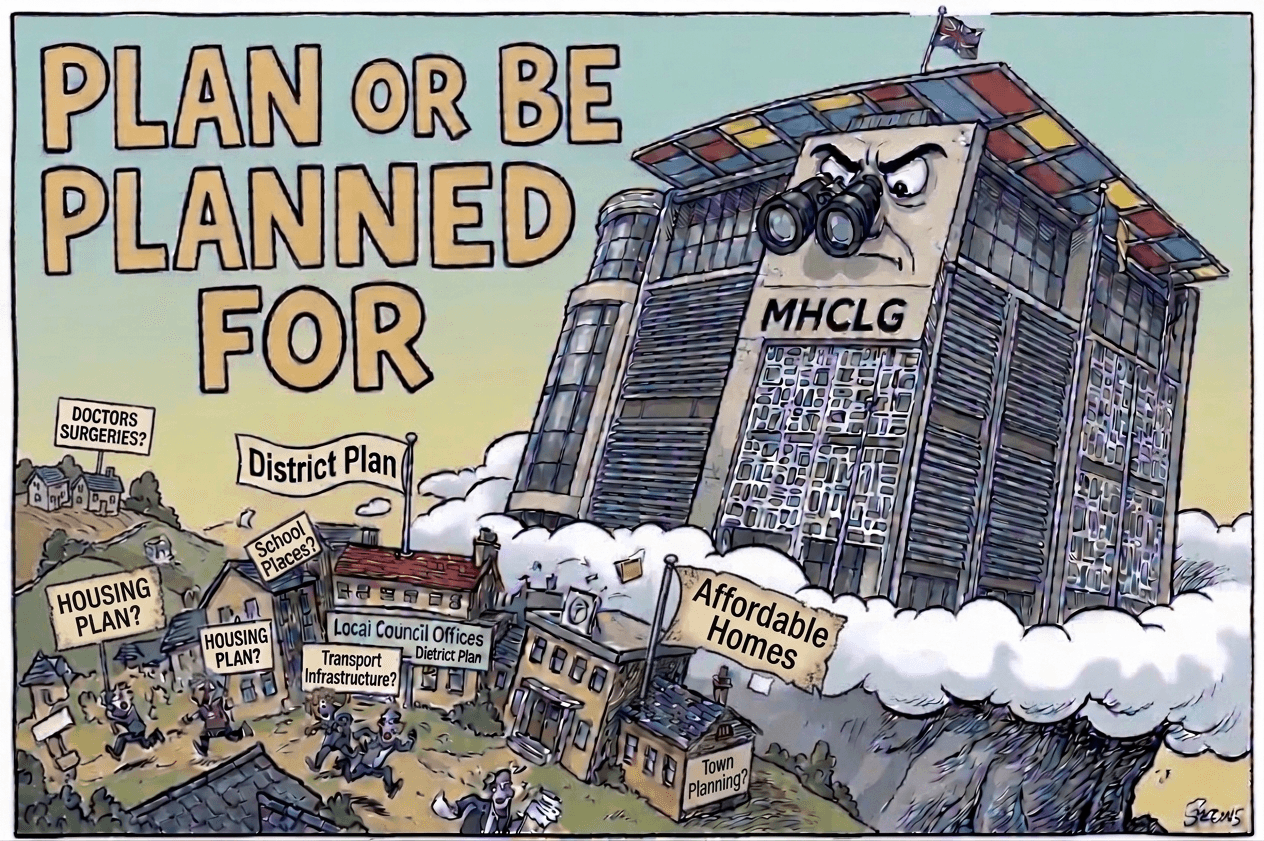
Plan or be planned for: the South East’s local plan problem
South East councils face rising housing targets, ageing local plans and growing government pressure. What do the new plan-making rules mean for councils and developers?
Across the South East, the gap between the homes the government wants and the plans in place to deliver them is widening. Many district councils are caught between ageing policies, rising housing targets and a government that has stopped being patient.
Where things stand
England has a plan-coverage problem. The number of up-to-date adopted plans is around 90, or 30% of all English local authorities, according to Savills. The South East is, in effect, working through the same backlog at regional scale, with a mixed picture across Kent, Surrey, Sussex, Hampshire, Berkshire and Oxfordshire.
Even where plans are moving, they are not doing so smoothly. Tonbridge and Malling in Kent is a stark example. Its last Local Plan was adopted in 2007, so the policies are 19 years old, and the Housing Delivery Test scores were 60% in 2023, 54% in 2024 and 63% in 2025. The council could not demonstrate a five-year housing land supply, with its latest published figure at 2.89 years, and local affordability was 12.03 against a South East average of 9.58. Yet its planning policies have been overtaken by events. South East Water has said its current supply planning does not leave enough headroom for the Council’s draft plan’s 19,000-plus new homes between 2024 and 2042. Housing numbers, infrastructure and sign-off from utilities are colliding.
Local government reorganisation adds uncertainty. The new East and West Surrey unitary authorities are due to go live in April 2027. Elsewhere it is not so clear. Councils are being asked to commit to 15-year growth strategies while unsure what authority they will be part of.
What it means without a plan or a five-year supply
For a district council, a missing or out-of-date plan has practical consequences. Policies lose weight, the council loses control over where development goes, and developers gain leverage.
The mechanics shifted with the August 2026 NPPF. The old “tilted balance” has been replaced. A failure to show five years of housing land, or a Housing Delivery Test result below 75%, can now amount to evidence of unmet housing need rather than switching on the old balance. In practice, that can support development outside settlement boundaries, while authorities with an up-to-date plan and a robust supply are better placed to resist speculative proposals.
The bar is also rising. From 1 July 2026, authorities whose adopted housing requirement is 80% or less of current need must add a 20% buffer to their five-year supply. Many South East plans were adopted on lower numbers and will be tested against it.
Older policies are also vulnerable. Local policies judged “materially inconsistent” with the new national decision-making policies should be given “very limited weight”. A plan adopted last year may not protect a council as much as it assumes.
The consequences are felt locally: planning by appeal, speculative schemes in places the community never expected, and infrastructure that follows development rather than leading it. For landowners and developers, the same conditions create openings. That is why the risk for councils is as much political as technical.
What the government is doing?
The government’s goal is universal plan coverage, and it is using both rules and pressure to get there.
A new plan-making system, introduced in March 2026. Plans prepared under the new system are designed around a 30-month timetable. It is built around three gateway checks.
Gateway 1: scope and strategic priorities. The council self-assesses its readiness to start the 30-month plan preparation period. It is effectively a readiness test, and the formal 30-month clock only starts once it has been passed.
Gateway 2: draft plan. This brings in the Planning Inspectorate mid-process to give observations and advice on soundness and progress. The Inspectorate appoints “gateway assessors” for Gateways 2 and 3. It is expected to take 4 to 6 weeks. After it, the council makes any necessary changes and consults on the proposed local plan.
Gateway 3: readiness for examination. The assessor reviews the plan against the requirements set out in regulations. It works on a pass/fail basis, and once a council passes it, it is expected to submit the plan for examination. It takes about 4 weeks, or up to 6 by exception, and a plan cannot go to examination without passing it.
Gateways 1 and 2 cannot be repeated unless the whole process is restarted. A failed gateway is therefore costly for a council.
A legacy sprint. Councils can still submit plans under the old system, but the window is closing. On 23 October 2026 the Housing and Planning Minister, Matthew Pennycook, extended the legacy submission deadline from 31 December 2026 to 31 March 2027, on condition that the final Regulation 19 consultation closes by 31 December, and said there would be no further extensions. The government has also revoked the Duty to Cooperate for legacy plans, previously one of the most common reasons plans failed.
Intervention. It has been reported that at least 11 councils in the South East have had intervention or holding directions published this year, ranging from fixed submission dates to requirements for extra housing sites. For example In Tonbridge and Malling, after the council chose not to progress its Regulation 19 plan, the Minister directed it to consult within days, submit by 31 December, not withdraw the plan and report monthly to officials. The Minister wrote to North East Lincolnshire citing the council’s failure to support the Regulation 19 consultation as clear evidence of a failure to do something necessary on the plan. The message to other councils is that pausing a plan carries a real risk of ministers taking over the timetable.
Pressure on inspectors. A new ministerial letter to the Planning Inspectorate in October reinforced the expectation that decisions should support housing delivery and growth.
The risks ahead
The reforms are ambitious, and the system may struggle to absorb them. Planning sources have projected around 115 local plan submissions in 2026/27, compared with 25 in 2025/26, creating an examination bottleneck. Oxford’s plan was held up when the High Court ordered the council not to submit pending a judicial review, and many councils have since added a Full Council meeting after consultation closes. Rushed plans may also be examined under one NPPF and then applied under another.
For South East councils, the position is clear. Pausing is no longer a safe option. Those with a credible plan, a defensible land supply and a clear view on infrastructure will retain control of where homes go. The rest are likely to find that decisions are made on appeal, or by ministers.
Explore More Insights
Discover more articles on planning policy, community engagement, and the political landscape shaping development.