The draft London Plan: a blueprint that has to survive its own politics
London’s draft plan proposes 558,000 homes while facing challenges over Green Belt release, borough opposition and infrastructure funding. Can the plan survive political scrutiny?
Sadiq Khan's draft London Plan sets a target of 558,000 new homes over the coming decade, with delivery numbers proposed for each of London's 33 local authorities. That is a long way short of what national policy asks of the capital. The consultation closed on 15 October, and the harder part now begins.
A plan caught between two audiences
The draft has to satisfy Whitehall and the boroughs at once, and it risks satisfying neither. The government's standard method says London needs 850,000 homes by 2037, so the Mayor's figure falls almost 300,000 short. City Hall's defence is pragmatism: private housing starts in the first quarter of 2026 were just 2,103, against the 22,000 a quarter that the standard method implies. The draft attributes the shortfall to a "perfect storm" of high interest rates, rising material costs and skills shortages.
That honesty creates a legal and political problem. National planning rules say strategies like the London Plan must set out to meet the standard method figure, and planning lawyer Simon Ricketts has argued that the gap puts the Mayor at odds with that requirement. Inspectors at next year's examination could demand changes. They could also reject the plan outright, an outcome nobody wants but one that cannot be ruled out. The draft also opposes Heathrow's third runway, which the government supports, so the friction with central government is not confined to housing.
The Green Belt: where the fight is
The most contentious element is the Mayor's change of position on the Green Belt. The draft identifies ten "broad locations" for a total of 56,100 homes, in Barnet, Enfield, Redbridge, Barking & Dagenham, Havering, Croydon, Hillingdon and Harrow. Around 90 per cent of development would still be on brownfield land, so Green Belt release is the minority share of the supply. Politically, it dominates the debate.
Hillingdon has emerged as the loudest critic. The council says it faces a ten-year target of 24,030 homes, more than double its current figure, and that it has been asked to release more Green Belt than anywhere else in London. Its Conservative leadership frames this as City Hall dictating the borough's future, and it also worries about the effect of Heathrow expansion. Croydon's elected mayor, Jason Perry, announced his opposition early and pledged to press for a more "collaborative" plan-making process through London Councils. Local reporting puts Croydon's share at 5,600 homes on greenfield or Green Belt land, on top of nearly 16,000 on brownfield sites.
Enfield shows how local politics can cut across the Plan. The Crews Hill new town proposal has been fiercely contested, and both the Conservatives and the Greens campaigned against building on the Green Belt there. The borough is now revisiting its release sites after a change of administration, which makes it a likely flashpoint for protracted opposition and legal challenge. Barnet, meanwhile, faces numerous potential Green Belt locations, and its Conservatives have criticised the draft. Even Labour-run boroughs are not uniformly enthusiastic. The London Assembly, which scrutinises the Mayor across party lines, has called on him to drop the Green Belt proposals.
Notably, the opposition is not purely partisan. Several boroughs had already declined to take part in the GLA's earlier Green Belt review, a point developers' advisers regretted at the time because Green Belt is a strategic, London-wide matter that should not be looked at borough by borough.
Delivery: a plan with conditions attached
Even the reduced target depends on things City Hall does not control. The draft says the 558,000 figure must be underpinned by infrastructure investment, including money for the Bakerloo line extension and the West London Orbital, plus a significant increase in affordable housing funding beyond the current £11.7 billion ten-year allocation, which is expected to fund only around 53,000 homes. The Plan is, in effect, a bid to the Treasury as much as a planning document.
The affordable housing framework adds complexity. A new three-tier system offers fast-track treatment to schemes that meet minimum thresholds. From 2028 the threshold returns to 35 per cent in twelve mainly inner boroughs, sits at 25 per cent in a middle ring of eight, and is 20 per cent in the remaining outer boroughs, with 50 per cent on Green Belt land and 40 per cent on public land. Developers will lobby for lower figures, while campaigners and some boroughs will argue the outer-London threshold is too low.
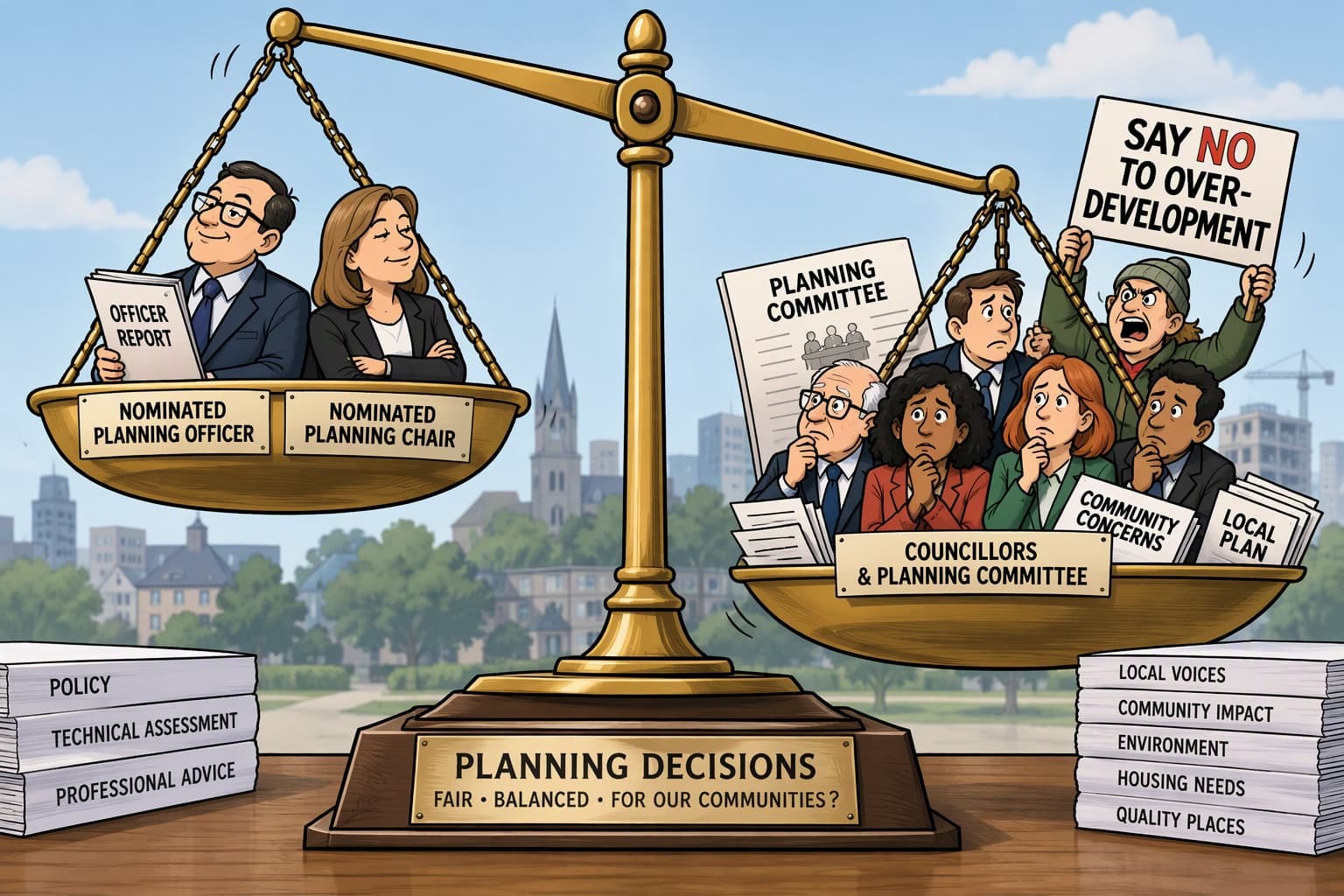
There is also a structural shift in who decides. New density rules explicitly stop councils acting separately from their local perspective, which means less scope for saying "no". Boroughs must bring their own Local Plans into "general conformity" with the London Plan, including on Green Belt release, so every contested site will ultimately be fought at borough level too.
The timeline
The sequence is now fairly clear, though each stage carries risk:
• 16 July to 15 October 2026: 13-week statutory consultation.
• Late 2026 and early 2027: City Hall considers responses and produces a revised draft.
• 2027: Independent Examination in Public.
• Early 2028: Final government sign-off is expected.
That endpoint matters politically. It falls close to the next mayoral election, due in May 2028, so the final shape of the Green Belt policy could become a campaign issue. The most plausible compromise is a trade: more Green Belt release or density in return for transport funding, or a government push for neighbouring authorities to absorb some of London's need. Either would please some constituencies and anger others.
What to watch
Three questions will decide whether this plan delivers. Will inspectors accept a target nearly 300,000 homes below the standard method? Will outer boroughs treat conformity as a duty or as a battle to be litigated? And will the government pay for the infrastructure the Plan depends on? The draft is candid about what London can realistically build. The next eighteen months will show whether candour is enough.
Key Takeaways
- The draft London Plan proposes 558,000 homes over ten years, below the standard-method figure cited in the article.
- Proposed Green Belt releases are politically contentious in several outer boroughs.
- Infrastructure and affordable housing funding will influence delivery.
- Examination, government approval and the 2028 mayoral election create further political uncertainty.
Explore More Insights
Discover more articles on planning policy, community engagement, and the political landscape shaping development.